How interesting it is that we humans tend to anthropomorphize1 everything!
Throughout history (and in current times), there are plenty of records of people who talk to trees and rivers and pretty much everything else in their environment. We usually think of that as silly, but remember that in our modern times, there are quite a lot of people who talk to machines!
If you think about it, there really isn't any difference between "trees/rivers/etc". and machines except for the fact that the machines answer back. Though, yeah, one could imagine that rivers and trees, etc., also answer back sometimes; it's just that they do so only to "special people".
What I find more interesting is how absolutely ubiquitous this is (I'm sure there's probably a name for it). We ascribe human nature to everything around us, from our homes to the darkness in our closets, to our coffee cups, the wind, clouds, our cars (people frequently name theirs), mountains, plants, pens, dogs, cats... I could go on and fill this whole post with names of stuff, as nothing is really above being "anthropomorphized".
Of course, some scientists do their best to close their eyes and pretend that anthropomorphizing stuff is a primitive, childish behavior. They do their best to suppress their own natural tendency to do so, but it's still there.
Something I wonder is just how far it goes. We know we do it with things in our vicinity, but do we also do it with each other? Is the fact that I perceive you as human contingent on me attributing those factors to you beforehand? I would say yes.
Then, what happens if someone were to lose that ability of recognizing "humanness"? Suppose you suffer an accident and the part of your brain that's in charge of anthropomorphizing stuff is irrevocably damaged. Would you find yourself in a world of moving, senseless objects? As I'm writing this, I realize that it's probably impossible for us to know how this would truly be. Still, it's an interesting thought: a world where nothing has human qualities, not even humans. Well, I guess you would perceive those in yourself once you notice your thoughts and feelings? Or maybe those would still be strange, dissociated phenomena to you?
...
I haven't had many experiences with psychedelics, but this whole discussion reminds me of the first time I took acid. I was already well into the trip, like two or so hours after it hit.
My friend (who was the "expert" at the whole acid thing) and I were walking in my garden, and it was starting to get dark, around 7 p.m., but the street lamps provided enough illumination to see. I remember seeing the stone walls of the garden and the plants, and I turned to my friend and said, "wow, there are faces everywhere".
And they were! Everywhere I looked, there was a face staring back at me. Every kind of face: happy, sad, angry, scared, laughing, loving.
I think this came directly from the same system that has us anthropomorphize stuff; it's just a deeply built-in mechanism.
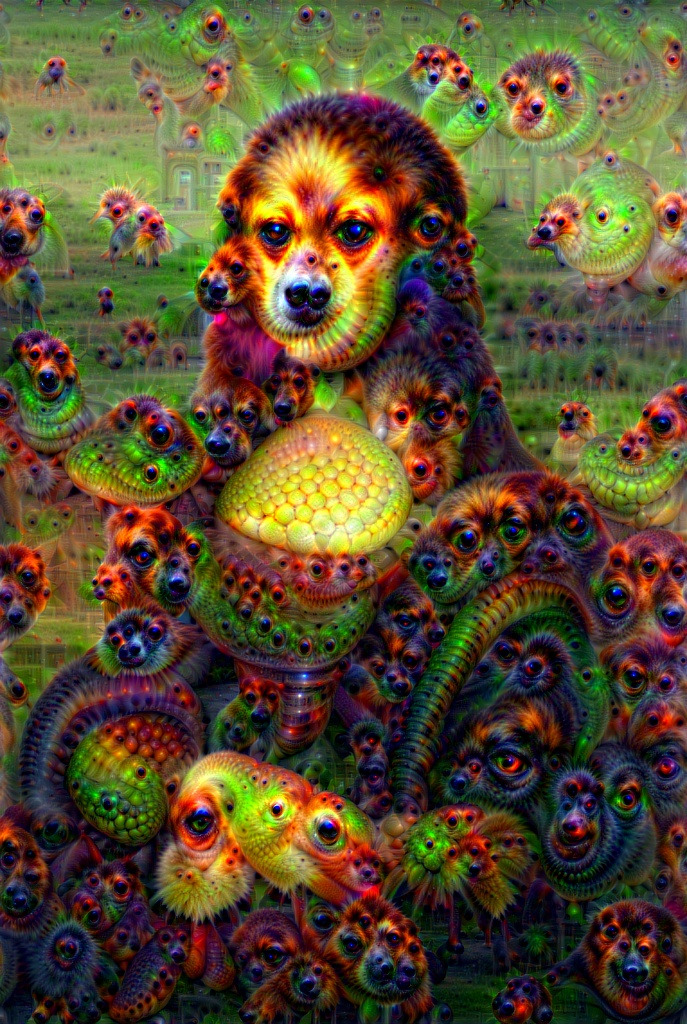
This reminds me of the beginnings of AI image generation. Long, long ago (2015), Google released a pretty neat program called DeepDream, which would basically use a pretrained model to enhance patterns it "saw" in input images. It would do this over and over until the pattern was clearly visible. Depending on what the user chose, it could enhance low-level patterns like edges and corners, or it could also enhance higher-level stuff like faces.
It turned out that when enhancing these "higher-level" patterns, the model would find lots and lots of dog and cat faces in the images! This was because the model was trained on a dataset of internet pictures, and there's a surprising amount of animal photos online (I guess people really liked to share how cute their pets were on MySpace or whatever they used back then).
This would create eerily fascinating pictures like this one (made by feeding the Mona Lisa through the system):
I'm not super happy with how this post came out. I think the idea and high-level structure is actually good, but it ended up a bit too convoluted and messy.
I guess that's alright, though, as that's what I set out to do with these word-vomits: publish without thinking that much about it.
Still, I feel like I should do a heavier editing pass, but since I don't have the time nor the energy to do it today, I guess I'll just write this "addendum" instead 😅
...
I feel the reason it came out this way was because I was not giving it my full attention. I was supposed to be doing other stuff and feeling guilty about writing. You can see that it feels a bit forced.
I can't help but ask myself "why am I doing this"? Well, on one hand, it's because I like a challenge. I also wanted to feel more connected to "writing" again. And the last reason was that I felt (and feel) that with practice my writing will improve. (I also hope that whatever resistance I have to the writing process will eventually burn down)
But will it improve if I just write forced posts? No, I don't think so. It won't improve by itself. I need to pay attention, tend to it, and nurture the process rather than treating it like a guilty pleasure I indulge in while hiding from my other responsibilities.
Anyway... This sort of thing is exactly what is needed in the "compost heap". There's valuable learning here (for me), even if the content turned out kind of meh.
Edit: I'm writing this shortly after having hit publish but I just thought about another cool example of this.
We think the lion to be evil for eating the gazelle, or the cat evil for killing the mouse, but the truth is that it's quite unlikely that either of these bear any malice or ill will to either the gazelle or the mouse. There might not be any anger or similar emotion involved in the whole process. Again, there's no "evil".
We just think there is because we "feel" for the prey (which certainly experiences some kind of fear), and we're relating to the whole thing from a human point of view.
Footnotes
-
Means "attributing human qualities, usually reason and morality, to inanimate objects". ↩